
The Hidden Cost Killing Your Profit Margins: A Complete Guide to Calculating Labor Burden for HVAC, Plumbing, and Electrical Contractors
If you pay a journeyman $35 an hour and estimate your jobs based on that $35 number, you're losing money every time they clock in.
This isn't a worst-case scenario. It's reality for the majority of HVAC, plumbing, and electrical contractors who don't understand labor burden. It's the gap between what you pay your employees and what they actually cost your business.
The result? You bid a job expecting a 20% profit margin and end up with 5%. Or worse, a loss. Meanwhile, you're working harder than ever, your team is busy, but somehow the money isn't there at the end of the month.
In this guide, I'm going to show you exactly how to calculate labor burden step-by-step, so you never underbid a job again.
Prefer watching? I walk through this entire blog post and all the calculations step-by-step:
Quick Navigation
Why Labor Burden Matters More Than You Think
What Costs are Included in Labor Burden
Step-by-Step: Calculating Labor Burden
Common Mistakes That Kill Margins
What Is Labor Burden?
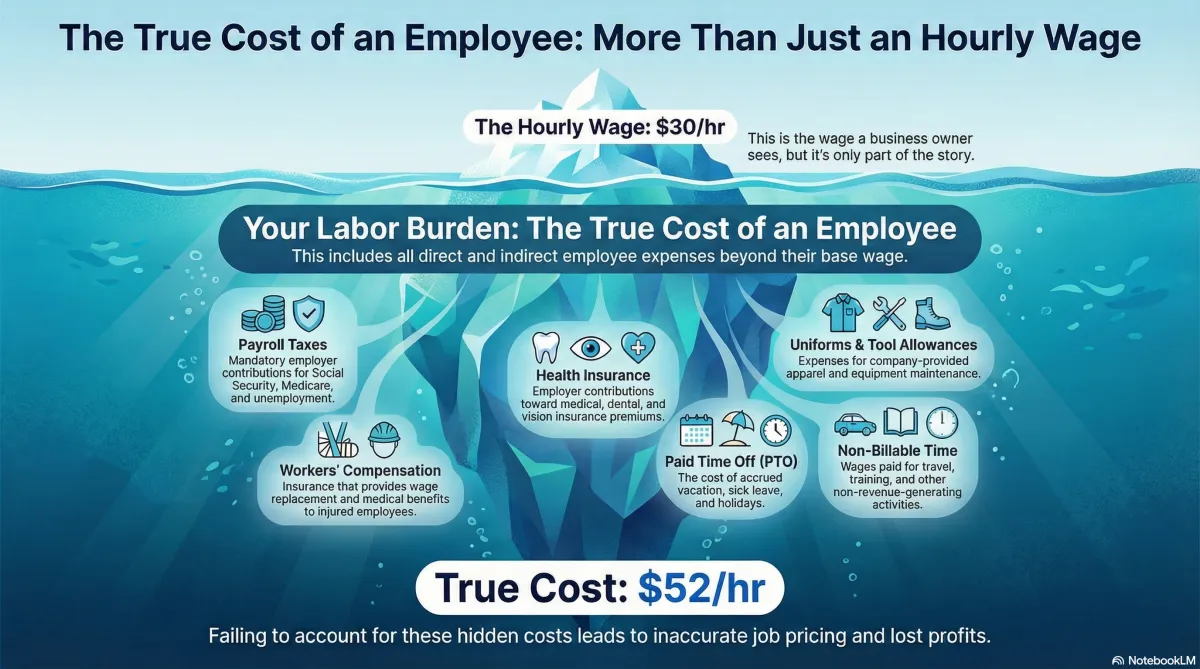
Labor burden is the total cost of employing someone beyond their gross wages. It includes:
Payroll taxes (FICA, FUTA, SUTA)
Workers' compensation insurance
Health insurance and benefits
Tools, uniforms, and equipment allowances
In the trades, labor burden typically adds 40-50% on top of the base wage. Here's a real example:
You pay Joe the journeyman $35/hour. Between payroll taxes, workers' comp (7%), health insurance ($500/month), uniforms, and tools... Joe actually costs you approximately $51/hour.
That $16/hr difference is your labor burden. And if you're not accounting for it in your pricing, every job you complete is eroding your profit.
Why Labor Burden Matters More Than You Think
Understanding labor burden affects literally every business decision you make:
Pricing: You can't set profitable rates without knowing your true costs
Hiring: You can't evaluate if you can afford another employee
Job profitability: You can't determine which jobs actually made money
Growth planning: You can't scale if your unit economics are broken
Cash flow: You can't understand why you're busy but broke
Most contractors know their revenue. They know what they pay their employees. But they have no idea what those employees actually cost. AND that's the difference between thriving businesses and struggling ones.
What Costs are Included in Labor Burden
These are the direct costs tied to employing a specific person:
Mandatory Payroll Taxes:
FICA: 7.65% (6.2% Social Security + 1.45% Medicare)
FUTA: 0.6% on the first $7,000 of wages
SUTA: Varies by state, typically 2-5%
NOTE: some states have additional payroll taxes like California's SDI or Washington's Paid Family Leave
Workers' Compensation Insurance:
This is a massive variable and often the single biggest component of labor burden in the trades. Rates vary dramatically by:
Trade specialty (inside wire vs. outside wire electricians vs roofers can have different rates)
State regulations
Your EMR (Experience Modification Rate) which is largely your claims history
NOTE: One bad safety year can spike your EMR and increase your workers' comp premium by 30% or more overnight.
Voluntary Benefits:
Health, dental, vision insurance (employer-paid portion)
Retirement contributions (401k matching)
Life insurance, disability coverage
Tool allowances and uniforms
Company phone, vehicle allowances
Continuing education, licensing, certifications
Watch me walk through this exact calculation in the video above, or download the free calculator and do it yourself as you read: Calculator Download Here
Step-by-Step: Calculating Labor Burden
Let's walk through a real calculation using "Journeyman Joe" as our example.

Scenario:
Base wage: $35/hour
Works 40 hours/week, 52 weeks/year
Standard benefits package
Step 1: Calculate Annual Base Wages
$35/hour × 2,080 hours (40 × 52) = $72,800/year
This is where most contractors stop. "I pay him $72,800, so I'll charge $45-50/hour and make a profit." Wrong. We're just getting started.
Step 2: Calculate Mandatory Payroll Taxes
FICA: $72,800 × 7.65% = $5,569
FUTA: $7,000 × 0.6% = $42
SUTA: $72,800 × 3.5% (example state rate) = $2,548
Total Payroll Taxes: $8,159
These are mandatory—no way around them.
Step 3: Calculate Insurance Costs
Workers' Comp: $72,800 × 7% (electrical rate) = $5,096
Total Insurance: $5,096
Note: Your workers' comp rate is tied to your EMR. One serious injury can spike this by 30%+ the following year.
Step 4: Calculate Benefits
Health Insurance: $500/month × 12 = $6,000
Retirement Match: $72,800 × 3% = $2,184
Other Benefits: Tools, uniforms, phone, training = $1,500
Total Benefits: $9,684
These aren't mandatory, but if you offer them, they're real costs you must recover in your pricing.
Step 5: Calculate TRUE Burden Hourly Wage:
Total Annual Cost:
Base Wage: $72,800
Payroll Taxes: $8,159
Insurance: $5,096
Benefits: $9,684
TOTAL: $95,739
TRUE Burden Hourly Wage: $95,739 ÷ 2,080 hours (52 weeks @ 40 hours) = $46.03/hour
The Result
Base Wage: $35.00/hour
TRUE Burden Hourly Wage: $46.03/hour
Labor Burden Rate: 31.5% (a $11.03/hour burden)
If you were bidding at $45/hour thinking you had a $10 profit margin, you're actually losing $1.03 per hour.
Multiply that across a 40-hour job: -$41
Multiply that across 2,080 hours per year: -$2,142 per employee
Multiply that across 5 technicians: -$10,712 in annual profit
And you're sitting there wondering why you're not profitable.
Part 2: Non-Billable Time (The Silent Killer)
This is where most contractors lose the game.
You pay your technician for 2,080 hours per year (40 hours × 52 weeks). But you cannot bill a customer for all of those hours.
Here's what you can't bill for:
Holidays: you can't bill for Christmas
PTO/Sick days: can't bill when they're at home
Training/safety meetings: necessary but not billable
Drive/Shop/Other Meeting time between jobs: Stocking truck, organizing, administrative tasks
Every hour you pay for but can't bill directly increases the cost of your billable hours. This is the efficiency gap that destroys margins.
Step 5: Calculate Non-Billable Time
Total Paid Hours: 2,080
Less: Holidays (6 days): -48 hours
Less: PTO/Sick (10 days): -80 hours
Less: Training (3 days): - 24hours
Less: Drive/Shop time (~5 hrs/week): -241 hours
True Billable Hours: 1,687
You're paying for 2,080 hours but can only sell 1,687. This 19% efficiency loss is critical.
Step 6: Calculate TRUE Hourly Cost
Total Annual Cost:
Base Wage: $72,800
Payroll Taxes: $8,159
Insurance: $5,096
Benefits: $9,684
TOTAL: $95,739
TRUE Hourly Cost: $95,739 ÷ 1,687 billable hours = $56.75/hour
The Result
Base Wage: $35.00/hour
TRUE Cost: $56.75/hour (Put this value in your FSM for job level costing)
Labor Burden Rate: 62% (a $21.75/hour burden)
If you were bidding at $50/hour thinking you had a $15 profit margin, you're actually losing $6.75 per hour.
Multiply that across a 40-hour job: -$270
Multiply that across 2,080 hours per year: -$14,040 per employee
Multiply that across 5 technicians: -$70,200 in annual profit
And you're sitting there wondering why you're not profitable.
But Wait—There's More: Overhead
Labor burden covers the cost of employing a specific person and is the But you also need to recover your overhead—the costs of actually running the business.
Labor Burden vs. Overhead

Labor Burden = costs tied to a specific employee
If you fire Joe, his payroll taxes disappear
His workers' comp premium goes away
His health insurance ends
These costs are directly tied to him
Overhead = costs that exist even with ZERO field technicians
Office rent and utilities
Office staff salaries (dispatcher, admin, bookkeeper)
Owner's salary (when you're NOT in the field)
Software subscriptions (ServiceTitan, QuickBooks, etc.)
Marketing and advertising
Company-owned vehicles
General business insurance
Legal and accounting fees
Bank fees, merchant services
Office equipment and supplies
The Golden Rule: Field technician costs go in labor burden. Everything else is overhead. Never double-count.
Calculating Your Customer Billing Rate
Let's add overhead to our example:
Annual Overhead: $255,000
Total Billable Hours (all techs combined): 8,435 hours
Overhead Per Hour: $255,000 ÷ 8,435 = $30.23/hour
Now we build the fully-loaded rate:
Joe's TRUE Burden Wage: $56.75
Overhead per hour: $30.23/hour
Break-even cost: 56.75 + 30.23 = $86.98/hour
This is your break-even rate. You're not making a penny of profit at $95.93/hour.
Want a 20% profit margin?
Minimum Billing Rate = $86.98 ÷ (1 - 0.20) = $108.73/hour
The Reality Check
That $35/hour employee?
You need to charge at least $108.73/hour to cover all costs and achieve a 20% profit margin.
That's 3.1× his base wage.
If you're charging $75/hour, you're losing money.
If you're charging $90/hour, you're barely breaking even.
If you're charging $50/hour... well, you're essentially paying customers to let you work for them.
This is why so many contractors are "busy but broke."
Common Mistakes That Kill Margins
Mistake #1: Using a Flat Burden Rate for Everyone
Your office administrator and your master electrician have wildly different burden rates:
Office admin: 25% burden (low risk, low workers' comp, desk job)
Apprentice electrician: 60% burden (lower wage, same fixed costs, high percentage)
Journeyman: 45% burden
Roofer: 70% burden (high risk, extremely high workers' comp)
Using a one-size-fits-all 40% rate means you're overbidding safe work and underbidding dangerous work. Calculate burden for each position type.
Mistake #2: Forgetting to Update When Costs Change
Your labor burden isn't static:
Workers' comp rates change annually based on your EMR
Health insurance premiums increase
State unemployment tax rates adjust
You add new benefits
Recalculate at least annually. If you have a bad safety year or your insurance renews, recalculate immediately.
Mistake #3: Not Tracking Actual Billable Hours
You might assume your techs are 90% billable. Pull the actual data from your service software.
If they're really only 80% billable, that 10% gap completely changes your rates. Track it, measure it, manage it.
Mistake #4: Confusing Burden and Overhead
This is the most expensive mistake:
WRONG: Adding your office manager's salary to labor burden
RIGHT: Office manager is overhead
WRONG: Adding company truck insurance to each tech's burden
RIGHT: Vehicle costs are overhead (unless truck is dedicated to one specific employee)
If a cost exists even when the employee is gone, it's overhead, not burden.
Industry Benchmarks: Are You Normal?
According to the Bureau of Labor Statistics, benefits and mandatory costs add roughly 44% to the base wage for construction workers.
Union vs. non-union:
Union burden rates: Typically 10-20 points higher (55-65%) due to pension contributions and negotiated welfare funds
Non-union: 35-50% depending on benefits offered
If your burden rate is:
Below 35%: You're either not offering competitive benefits, or you're missing costs in your calculation
35-50%: Normal range for most trades
Above 50%: Either high-risk trade, generous benefits, or low utilization rate
What to Do Right Now
Here's your action plan:
1. Calculate Your TRUE Labor Cost
Download the calculator and calculate it for every field employee.

2. Calculate Your Total Annual Overhead
Add up everything that's not tied to specific field employees:
Rent, utilities
Office staff
Owner's non-billable time
Software, marketing
General insurance
Professional fees
Be brutally honest. Don't forget "small" costs that add up.
3. Determine Your Overhead Per Hour
Total Annual Overhead ÷ Total Billable Hours (all employees combined)
This number gets added to every labor hour you sell.
4. Set Your Minimum Billing Rates
For each employee type:
Minimum Rate = (TRUE Labor Cost + Overhead/hour) ÷ (1 - Target Profit %)
This is your floor. Never go below it.
5. Update Your Estimating System Immediately
Don't wait until next quarter. Every job you bid using incorrect labor rates costs you money. Typically the burden hourly wage is what belongs inside your FSM.
Update your rates in:
ServiceTitan
Housecall Pro
FieldEdge
QuickBooks
Whatever system you use
Then train your estimators on the new rates and WHY they changed.
State-Specific Considerations
Labor burden varies significantly by state due to different tax structures:
States with Additional Payroll Taxes:
California: SDI (1.1%) + Employment Training Tax (0.1%)
Rhode Island: Temporary Disability Insurance (1.3%)
Nevada: Career Enhancement Program (0.05%)
New York: Disability Benefits + Paid Family Leave (~0.5%)
Washington: Paid Family Medical Leave (0.8%)
Oregon: Paid Leave Oregon (~1.0%)
New Jersey: Complex multi-part system (~2.5% additional)
Massachusetts: Paid Family Medical Leave (0.88%)
Make sure you're accounting for YOUR state's specific requirements. The free calculator includes all 50 states but check your pay stubs to ensure nothing is missed.
Special Case: Owner-Operators
If you (the owner) work in the field, here's how to handle it:
Calculate your market-rate wage for the work you do:
What would you pay someone else to do your job?
Add yourself to the roster at that wage
Then reduce your Owner Salary in overhead by that amount:
Example:
You pay yourself $100,000 total
You work 50% in the field (as a tech)
Add $50,000 to labor burden (as a field tech)
Put $50,000 in overhead (as owner/manager)
This prevents double-counting while accurately capturing where your time goes.
The Bottom Line
You didn't get into the trades to be an accountant. You got in because you're great at HVAC, plumbing, or electrical work.
But you also deserve to be profitable. You deserve to know that every job you complete is actually making you money, not slowly bleeding your business dry.
Labor burden is the foundation of profitable pricing. Without it, you're guessing. And guessing in business leads to one place: broke.
The good news? You don't have to guess anymore.
I've created a comprehensive Excel calculator that does all of this math for you. It handles:
Multiple employee types with different burden rates
All 50 states (including state-specific payroll taxes)
Overhead allocation
Final customer billing rates
Traditional burden rate vs. TRUE hourly cost
Plug in your numbers and you'll know your TRUE costs in 10 minutes.
Need Help Implementing This?
If you want someone to review your numbers, clean up your books, and make sure you're pricing for profit, that's what we do at Accounting 4 Trades.
We work specifically with HVAC, plumbing, and electrical contractors because we understand how your business actually works. No generic advice, no cookie-cutter solutions.
Book a Free Consultation: https://meet.acc4t.com/discovery
No sales pitch. Just a real conversation about your numbers and how to fix what's broken.
Frequently Asked Questions
Q: Should I include my project manager's salary in labor burden?
A: Generally, no unless they're dedicated 100% to a single job. If your PM oversees multiple jobs, their cost is overhead and should be recovered through your overhead markup, not labor burden.
Q: How often should I update my labor burden calculation?
A: At minimum, annually. But also update whenever your workers' comp EMR changes, your health insurance renews, or you add/change benefits. A bad safety year can spike your burden rate overnight.
Q: Can I just use a flat 30% burden rate for everyone?
A: Only if you hate money. An office admin might have a 25% burden (low risk, low workers' comp). A roofer might have a 60% burden (high risk, extreme workers' comp). Using a flat rate means you'll overbid safe work and underbid risky work.
Q: What if my rates are way higher than my competitors?
A: Your competitors are probably calculating wrong too (or going out of business). Price on YOUR costs, not theirs. Profitable contractors set rates based on real numbers, not wishful thinking.
Q: Should overtime hours have a different burden rate?
A: Yes! When an employee works overtime (1.5× wages), payroll taxes and workers' comp apply to the inflated wage. But health insurance stays flat. Your overtime burden rate should actually be slightly lower on a percentage basis but much higher in dollar terms. Calculate it separately.