
Electrical Contractor Bookkeeping:
The Complete 2026 Guide to 20% Net Margins
Why General Bookkeeping Fails Electrical Contractors
Most electrical contractors discover they lost money on a job six months after it's completed when it's too late to fix it. The difference between contractors who scale profitably and those stuck at $1-2M isn't technical skill; it's financial visibility. In 2026, the electrical contractors hitting 15-25% net margins aren't working harder. They've built financial systems that show profit in real-time, not at tax season.
Modern electrical business growth relies on a shift from cash-basis tracking to proactive accrual accounting and real-time job costing integration. To protect the 15%–25% net profit margins typical of top-performing contractors, owners must master fully burdened labor rates, recurring revenue, and ensure field service data flows accurately into their general ledger without double entry.
The Critical Shift: Moving Beyond Generalist Bookkeeping
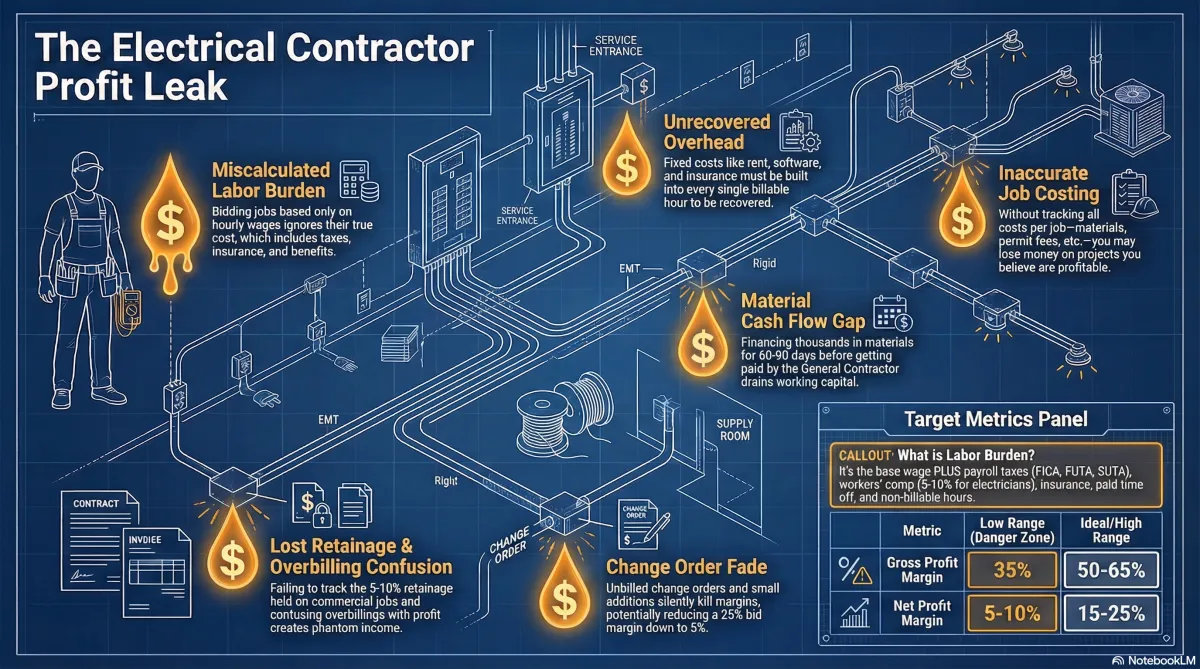
The most common reason electrical contractors plateau at the $1-2M revenue mark is the "Busy but Broke" paradox. You may have a full schedule and three weeks of backlog, yet find your bank account stagnant or shrinking. This occurs because generalist bookkeeping often ignores the granular operational realities unique to the electrical trade.
Why Generalist Accounting Fails the Electrical Owner
While a generalist can balance a checkbook, they often lack the industry-specific lens required to spot these four profit killers:
The Labor Burden vs. Hourly Rate Trap:
Generalists often view payroll as a simple expense. A trade specialist identifies your fully burdened labor rate. If you pay a tech $30/hr, your true cost is often $50/hr+ once you factor in payroll taxes, high-premium workers' comp, PTO, training, retirement, non-billable time, insurance, rent, software, and vehicle overhead. If you aren't accounting for this burden allocation, your seemingly "profitable" jobs are actually draining your cash reserves.
The Material Float Crisis:
Generalists see material purchases as expenses when paid. Without tracking materials-to-job allocation, you won't know your true profit. Without maximizing vendor terms, you're draining your cash before you're even paid.
Departmental Blind Spots:
Generalists typically use a "one-bucket" approach. They show you your total profit, but they can't tell you if your Generator department is losing money while being "carried" by your Residential Service department. Without departmentalized or job-level reporting, you are essentially flying blind.
Weak Cash Flow Management:
For electrical contractors, cash is the lifeblood of growth. Generalists often fall behind on revenue recognition. Delayed invoicing, failure to collect on unpaid receivables, and failing to leverage vendor terms means your cash is often going out the door faster than it is coming in, strangling your ability to scale.

Implementing the "Matching Principle"
For an enterprise-level fleet, your accounting must move away from simple record-keeping. While a small operation can survive on cash-basis tracking (recording income only when checks clear), a scaling fleet requires accrual accounting.
This allows you to utilize the matching principle: recording your equipment costs and labor in the exact same month the revenue is recognized. This prevents the "financial amnesia" that occurs when a P&L statement looks profitable in July simply because you haven't paid the equipment vendors for those June installs yet.
The 2026 Tech Stack: Establishing a Single Source of Truth
In 2026, manual data entry is more than just an inefficiency; it is a significant liability that invites human error, duplicate entries, and unnecessary audit risk. To achieve true field service profitability, your technology must function as a seamless ecosystem where Field Service Management (FSM) tools and your accounting software act as a unified machine.
The Hub-and-Spoke Financial Model
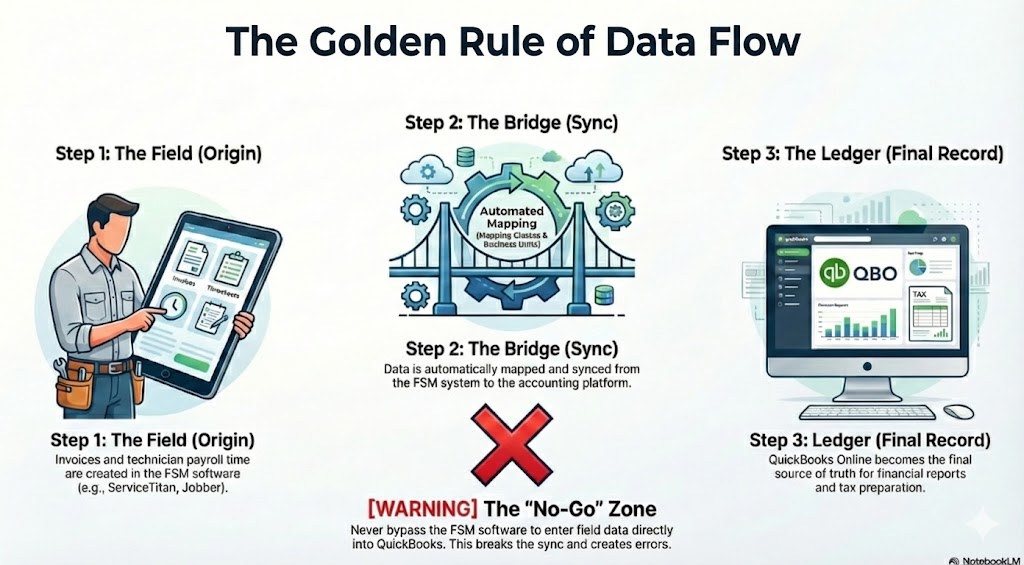
Think of QuickBooks Online (QBO) as the central hub of your financial wheel. It is your permanent record and the source of your tax filings. Your FSM tools, whether you use ServiceTitan, Jobber, or Housecall Pro, are the "spokes." They handle the high-velocity data of the field: dispatching, equipment serial numbers, and real-time technician timesheets.
The critical principal: Data flows one direction only; from the field (FSM) to the office (QBO). Never the reverse.
Avoiding "Sync Drift" and Mapping Disconnects
The most frequent technical failure we see in electrical bookkeeping is Sync Drift. This occurs when the bridge between your field operations and your ledger begins to fail due to mapping disconnects.
If your FSM "Business Units" or "Departments" are not perfectly aligned with your QuickBooks "Classes," your departmental reports will become distorted. Sync Drift creates a dangerous illusion: you might believe your Generator team is thriving, when in reality, they are being subsidized by the high margins of a Residential Service department. Without precise mapping, your P&L is essentially a work of fiction.
The Golden Rule: The Direction of Data
To maintain data integrity and a reliable audit trail, you must adhere to one non-negotiable rule: Every transaction must originate in the FSM.
From the initial digital invoice created on a tablet to the final payment collected at the kitchen table, the data must flow downstream from the field to the office. Entering an invoice directly into QuickBooks bypasses your operational reporting, breaks your job costing, and destroys your ability to track equipment history.
The Price Book: The Bridge Between Field and Finance
Your Price Book is the most critical piece of real estate in your tech stack. It isn't just a list of parts and labor; it is the translation layer between your technicians' work and your financial reports.
Granular Mapping: Each task in your price book must be mapped to the correct Income and COGS accounts.
Inventory Accuracy: In 2026, if you're tracking real-time inventory, it must be setup correctly. When a tech pulls a motor from a van, your FSM should automatically trigger the corresponding expense in QBO, preventing "phantom profit" from sitting on your warehouse shelves.
The Framework: Chart of Accounts (COA) & Classes
A generic Chart of Accounts is the enemy of a 15-truck fleet. To act as a CEO, you require a trade-specific COA that categorizes transactions correctly while using Classes to provide departmental visibility.
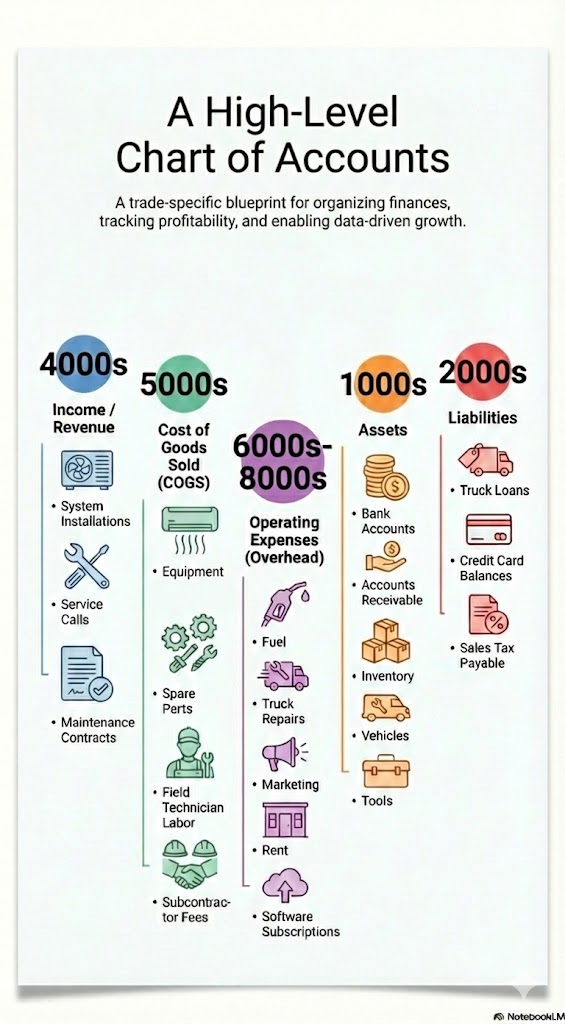
The "Skeleton": Industry-Standard Numbering
A well-organized COA uses consistent numbering conventions to make financial reports transparent and easy to filter.
1000s: Assets
Bank Accounts, Buildings, Vehicles, Equipment
2000s: Liabilities
Loans, Credit Cards, Payroll Taxes
3000s: Equity
4000s: Revenue
High-level income categories.
5000s: Cost of Goods Sold (COGS)
Direct job costs like materials, direct labor, permits, and subcontractors.
6000s: Operating Expenses
Overhead items like office wages, advertising, vehicles, rent, fuel, and software.
The "Sensors": Using Classes for Departmental Reporting
Do not overcomplicate your COA by creating separate accounts for every department. Instead, use the "Classes" feature in QuickBooks Online to tag transactions by business unit.
Visibility: By using one "Income" account but tagging entries with a "Residential Service" or "System Install" class, you can run a Profit & Loss by Class report.
Insight: This allows you to identify that a high-revenue installation department might actually have lower net margins than your service department.
Looking for a template? Download our Free Electrician-Specific Chart of Accounts here.
Job Costing: Know Your Profit Before the Invoice Goes Out
Most electrical contractors discover their financial losses at tax time; months after a project is completed, when it's too late to correct course. A generic Profit and Loss (P&L) statement can tell you if the company made money overall, but it cannot tell you which specific jobs generated that profit and which ones eroded it.
In an industry where net profit margins often hover between 2% to 6%, relying on end-of-year "autopsies" of your finances is a dangerous strategy. True financial control comes from real-time job costing that reveals the profitability of every panel upgrade, lighting retrofit, and commercial build-out before the final invoice is sent.
Without job-level tracking, you're making critical business decisions blind: Which types of work should you pursue more of? Which crews are most efficient? Should you raise prices on certain services? Generic bookkeeping can't answer these questions but specialized job costing can!
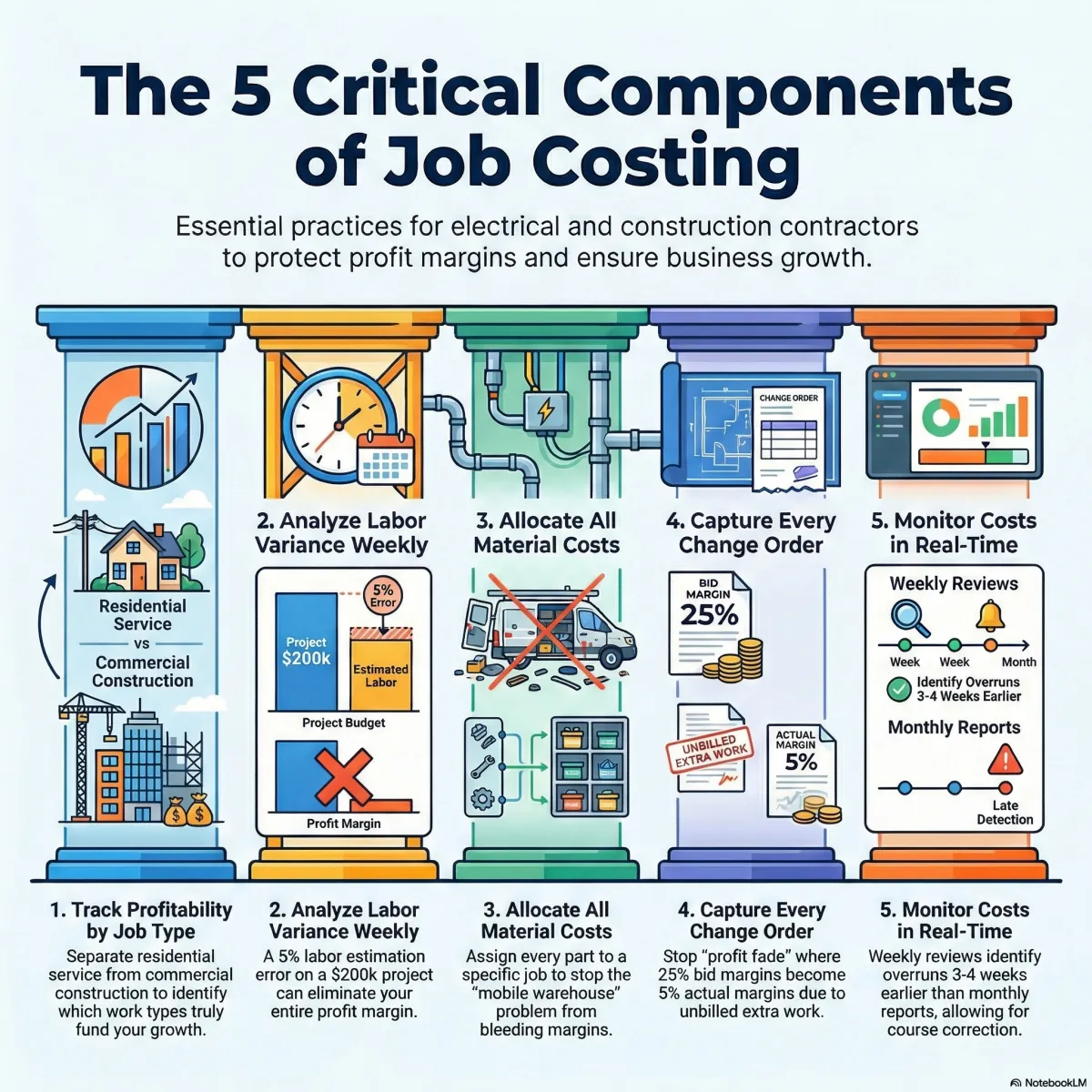
The Five Critical Components of Job Costing:
Job-Level Profitability Tracking - Separate residential service (65-67% margins) from commercial construction (15-25% margins) to identify which work types fund your growth.
Labor Variance Analysis - Track estimated vs. actual hours weekly. A 5% labor estimation error on a $200k project can eliminate your entire profit margin.
Material Cost Allocation - Allocate every wire nut and breaker to specific jobs to prevent the "mobile warehouse" problem from bleeding margins.
Change Order Capture - Stop "profit fade" where 25% bid margins become 5% actual margins due to unbilled extras.
Real-Time Monitoring - Weekly job cost reviews identify overruns 3-4 weeks earlier than monthly reviews, allowing course correction while projects are active.
Building Predictable Cash Flow with Recurring Revenue
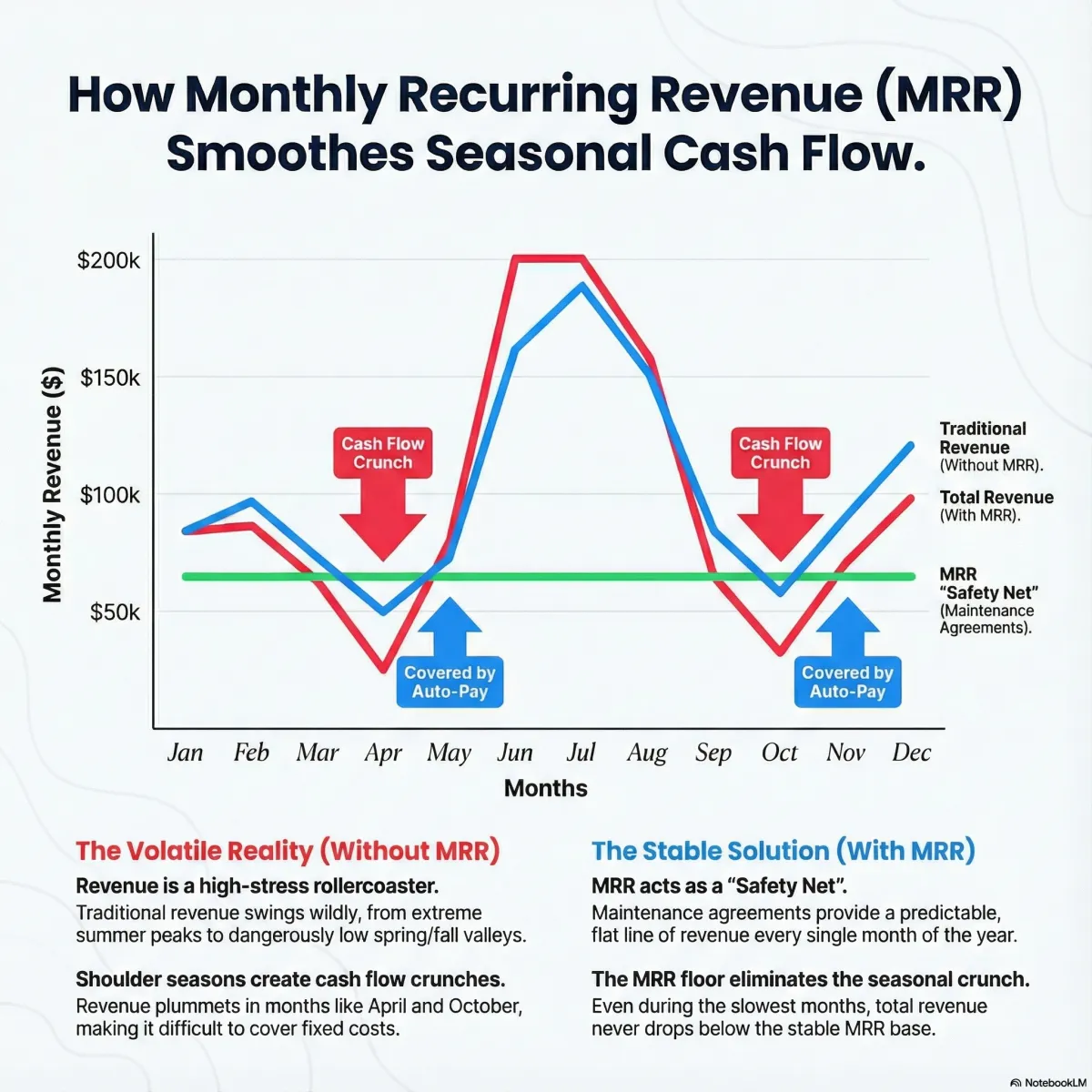
For electrical contractors, project-based work creates the feast-or-famine cycle: one month you're billing $200K on a commercial build-out; the next, you're scrambling to cover payroll. This volatility makes it impossible to forecast cash flow, plan for growth, or maintain consistent profitability.
The solution: Build a foundation of Monthly Recurring Revenue (MRR) through service agreements that generate predictable, automatic income every month regardless of new project flow.
Why Recurring Revenue Matters
Predictable Cash Flow: Monthly billing covers baseline costs (payroll, insurance, vehicles, rent) even during slow project months.
Higher Valuation: Buyers pay premium multiples for recurring revenue. A $2M company with $500K in maintenance contracts is worth significantly more than one relying on one-off projects.
Customer Retention: Clients on maintenance plans call you first for additional work, dramatically reducing acquisition costs.
Four High-Value Recurring Revenue Streams
Commercial Preventive Maintenance - Quarterly electrical safety inspections, thermal imaging, panel cleaning
Generator Maintenance Contracts - Load testing, oil changes, battery replacement for hospitals, data centers, manufacturing
Annual Safety Inspections - Arc flash studies, infrared thermography, code compliance for insurance requirements
EV Charging Station Services - Software updates, connector maintenance, priority response
Tracking MRR Performance
Generic bookkeepers lump maintenance revenue with project revenue. Specialized bookkeeping separates and tracks:
Monthly Recurring Revenue growth
Churn rate (canceled vs. renewed contracts)
Revenue per agreement type
Customer lifetime value
Bottom line: The electrical contractors scaling past $5M aren't just chasing bigger projects, they've built a foundation of predictable monthly income that funds their growth.
Beyond the Bank Balance: Contractor Cash Flow
Profit is a theory; cash is reality. Many electrical contractors fall into the trap of inadvertently "financing the job"; fronting the substantial costs for labor, copper, and gear weeks or months before seeing a dime from the customer. To bridge this liquidity gap and ensure your working capital isn't trapped in someone else's building, you must aggressively manage the timing of your inflows and outflows. It isn't enough to just win the bid; you must structure your financial operations to accelerate collections and optimize your credit

Keep More Cash In Your Bank:
Same-Day Billing: You should not wait until the end of the week to invoice. Ideally technicians invoice and collect payment before they even leave.
Maximizing Supplier Terms: While you push customers for Net 15 (or due on receipt), you should negotiate Net 60 or Net 90 terms with your suppliers. This allows you to install materials and (hopefully) get paid by the customer before the supply house bill is due.
Review WIP Reports: For commercial projects with AIA/WIP billing, ensure your WIP reports highlight overbilling and retainage so that you understand if the cash in your bank is actually usable.
The 7 Essential KPIs every Electrical Owner Should be Tracking
As you transition from technician-owner to CEO, you must manage by the numbers rather than by "gut feeling". These seven metrics represent the "vital signs" of a healthy, enterprise-level operation:
KPI
2026 Benchmark
The Bookkeeper's Perspective
Gross Profit Margin
50-65%
Crucial: If GPM is low, your pricing is wrong or your costs are too high. This is the first number we fix.
Net Profit Margin
>10-15%
Are you actually creating wealth or is overhead eating all of your Gross Profit?
Technician Efficiency
80-85%
We track billable hours vs. paid hours. If this is low, you have a "scheduling leak" that's draining your payroll.
Accounts Receivable Days
< 10 Days Ideally
Minimal balances over 30 days
We monitor how fast cash moves from the field to your bank. As you scale, the longer you provide free loans to customers, the more of a cash crunch your business will feel.
Overhead as a Percentage of Revenue
< 25-35% of Revenue
If this percentage creeps up without a corresponding rise in revenue, the business is becoming top-heavy or inefficient.
Revenue per Employee
$300,000+
Ensure that each and every employee generates enough revenue to cover margins and overhead
Customer Acquisition Cost (CAC)
< $150
Ensure marketing spend is yielding an appropriate ROI and that revenue is growing with marketing spend. If they diverge, then the sales or marketing process needs refinement.
The Golden Rule of KPIs: Data Freshness
A KPI is only useful if it is current. If your bookkeeping is three weeks behind, you are looking at a "rearview mirror" rather than a GPS. In a large fleet, a 5% drop in efficiency can cost thousands of dollars in a single week. Professional bookkeeping ensures these numbers are updated in near real-time, allowing you to make course corrections before a minor leak becomes a flood.
Scaling Your Professional Oversight: The 2026 Roadmap
Scaling a fleet is as much about administrative infrastructure as it is about adding trucks. As your revenue grows, the "who" behind your numbers must evolve to match the complexity of your operations.
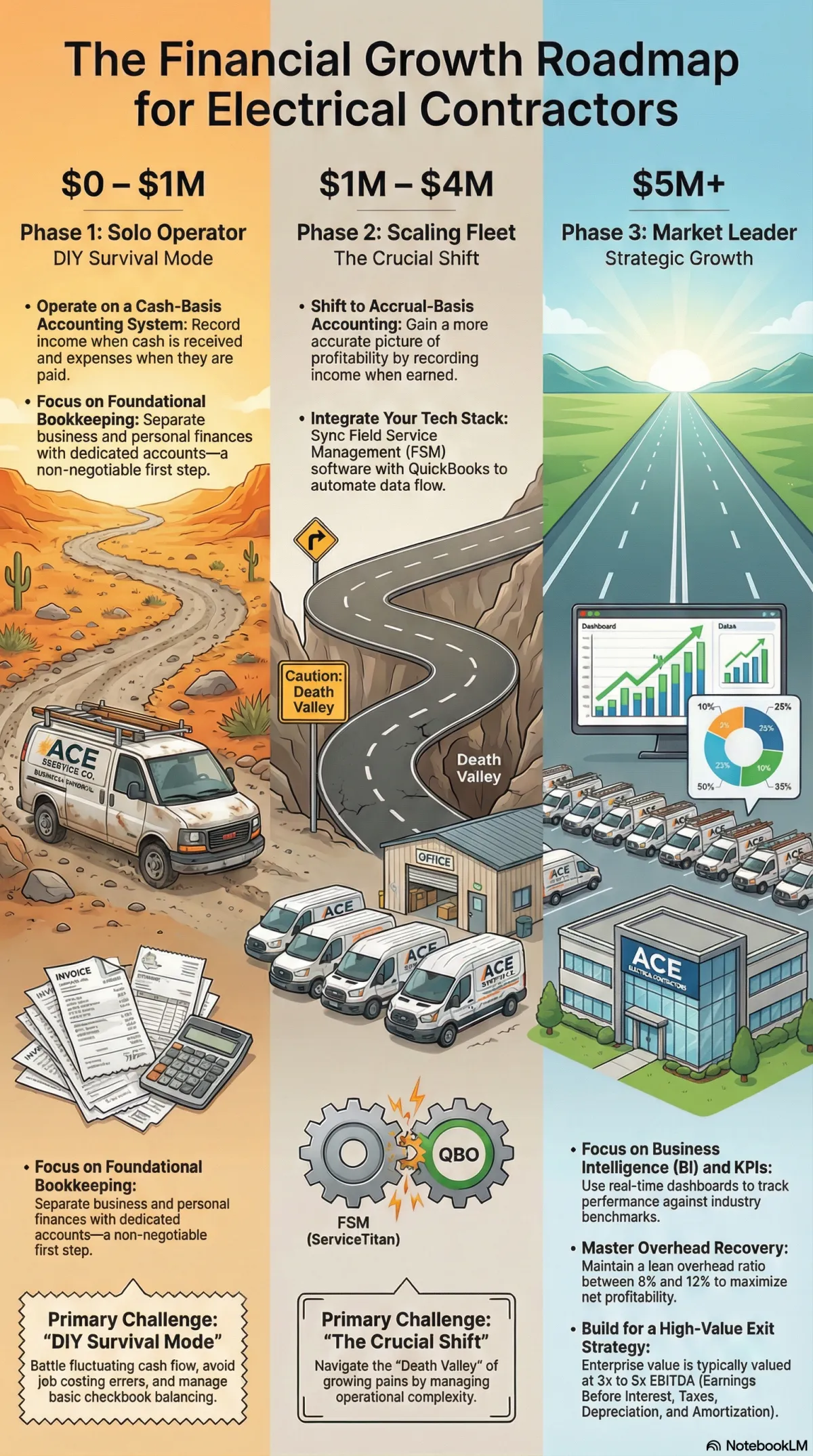
Phase 1: The Foundation ($0 – $1M)
The Oversight: Usually the Owner or a multi-tasking Office Manager.
The Workflow: Bookkeeping is often "retrospective," focusing on bank reconciliations and paying bills.
The Risk: Data is often siloed or even stored in a shoebox. If the owner is busy in the field, invoices get delayed, and "financial amnesia" sets in regarding unrecorded field expenses.
Phase 2: The Transition & "Death Valley" ($1M – $4M)
This is where most companies plateau or fail. The complexity of managing 5–8 trucks outstrips the capacity of a generalist. Projects start to grow larger, but cash flow can slow or decrease with larger upfront material costs.
The Oversight: Partnering with a fractional electric-specific bookkeeping firm (like Acc4t).
The Workflow: Shifting to Accrual Accounting and automated FSM-to-QuickBooks syncing.
The Value: You stop just "tracking expenses" and start practicing Overhead Recovery. At this stage, specialized oversight pays for itself by identifying the 5%–10% of profit currently leaking through unapplied labor and improper job costing.
Phase 3: The Enterprise ($5M+)
The Oversight: A hybrid model. You likely have an in-house Administrative Assistant for daily tasks, supported by a specialized firm for high-level Business Intelligence (BI), bookkeeping, and tax strategy.
The Workflow: Advanced KPI monitoring, multi-year tax planning, and preparing the books for a high-value exit or private equity acquisition.
The Goal: Total financial transparency. You can tell exactly which service lines, technicians, and marketing channels are driving your EBITDA.
Frequently Asked Questions
What is the best accounting software for Electrical companies?
QuickBooks Online (QBO) is the undisputed industry standard for 2026. While Xero and Sage are capable, QBO has the most robust API integrations with the leading Field Service Management (FSM) tools like ServiceTitan, Jobber, and Housecall Pro. Using QBO ensures your "Financial Hub" can actually talk to your "Operational Spokes."
How do I set up a trade-specific Chart of Accounts (COA)?
Instead of dozens of accounts, use a clean structure (4000s for Revenue, 5000s for COGS) and utilize Classes in QuickBooks to distinguish between Service, Install, and Maintenance.
Make it easy on yourself: Download our Free Chart of Accounts here.
Can I manage my Electrical bookkeeping using only spreadsheets?
Only if you intend to stay a solo operator and even then QBO would make your life easier. Spreadsheets are "dumb" data; they don't sync with your bank, they don't track labor burden automatically, and they are prone to human error. Once you have more than two trucks, the time spent managing spreadsheets is more expensive than hiring a professional.
What is a healthy net profit margin for a residential electrical company?
A healthy, well-managed electrical business should aim for a net profit margin of 10% to 20%. Operating below 10% is considered a "vulnerability zone"
How do I calculate "Labor Burden" for my technicians?
Raw wages are just the beginning. To find your Fully Burdened Rate, you must add:
Taxes: FICA, SUTA, FUTA.
Insurance: Workers' Comp (High-premium for trades), Health, Liability.
Benefits: 401k, PTO accruals, non-billable hours
A tech paid $30/hr usually costs the company $52/hr+.
Your billable rate should also include your overhead like rent, vehicles, and insurance.
How do Electrical companies manage cash flow during the "shoulder season"?
As of 2023, NFPA 70B transitioned from a recommended practice to a mandatory standard for electrical equipment maintenance. This creates a massive opportunity for electrical contractors to offer recurring Electrical Maintenance Programs (EMPs) to clients. These maintenance contracts provide steady, recession-resistant revenue and increase business valuation. Additionally, we recommend scheduling all non-emergency maintenance tune-ups during the slow winter to keep your techs billable during these slowdowns.
How often should I review my financial statements?
At a minimum, once a month. However, for a 10+ truck fleet, we recommend a weekly KPI pulse check on Technician Efficiency and Accounts Receivable. If you wait until the end of the quarter to see you're losing money, it’s often too late to fix the cause.
How do I handle unpaid invoices and slow-paying customers?
Implement "Payment in the Field" as a standard. Use your FSM (like ServiceTitan) to collect credit card or financing payments before the tech leaves the driveway. For commercial work, maintain a strict 10-day DSO (Days Sales Outstanding) follow-up process.
When should an Electrical company hire a professional bookkeeper?
The tipping point is usually when your time is better spent making money for the business rather than spending it on admin tasks that you can offload. At two to three trucks, the complexity of expense, payroll, and job costing becomes a distraction from your primary role: growing the business.
And hiring an office manager than can effectively run dispatch, answer telephones, manage customers, fill out warranty paperwork, and manage the bookkeeping would be a unicorn of talent. Keep them forever!
Are vehicle and fuel expenses fully tax-deductible?
Yes, but how you deduct them matters. For 2026, most fleets benefit from Section 179 deductions for new vehicle purchases and "Actual Expense" tracking for fuel and maintenance. Your bookkeeper should ensure every truck is its own asset category for precise depreciation tracking.
What is the most common financial error in a 10-truck Electrical business?
Failing to reconcile Undeposited Funds and "Clearing Accounts." If your FSM says you collected $50,000 but your bank only shows $48,000, that $2k gap is often lost in "sync errors." If you don't reconcile this, you will pay taxes on money you never actually received.
Should I use flat-rate or T&M pricing?
Flat-rate pricing is superior. It eliminates "customer clock-watching" and allows you to bake your labor burden and overhead into every task. It rewards your fastest, most skilled technicians without penalizing your profit margins.
Final Thought: Your Books are Your GPS
Running a multi-truck electrical business without specialized bookkeeping is like troubleshooting without a multimeter. You can see the lights are on, but you have no idea if the wiring is dangerously overloaded or just one amp away from tripping the main breaker
Is your business set for 20% profit in 2026? Schedule a 2026 Financial Leak Detection with Acc4t today.
90-Day Moneyback Guarantee
We stand by our work—no excuses, no fine print. If you're not 100% satisfied within the first 90 days, we'll refund up to 50% of one-time investments or 100% of recurring service fees. Your success is our priority, and we’re confident in delivering results that matter.
Accounting 4 Trades




Copyright 2026
All Rights Reserved
https://storage.googleapis.com/msgsndr/p98iMZ6oQEd0B8FNCsvk/media/678a7c4da120156f79a7e704.jpeg
https://storage.googleapis.com/msgsndr/p98iMZ6oQEd0B8FNCsvk/media/67763277b0a11f9c9fbd213c.jpeg