
Money Was Disappearing From a Contractor's Business. His Books Showed Exactly Why.
Employee theft in a contracting business doesn't usually look like theft. It looks like a slow, unexplained gap between what you're billing and what's in your bank account.
A trades client called me in a panic. Money was disappearing and he didn't know where. He'd been watching his bank account come up short for months. He'd already reviewed his pricing, looked at material costs, and questioned whether he was running jobs efficiently enough. None of it explained the gap.
How Contractor Bookkeeping Caught Employee Theft
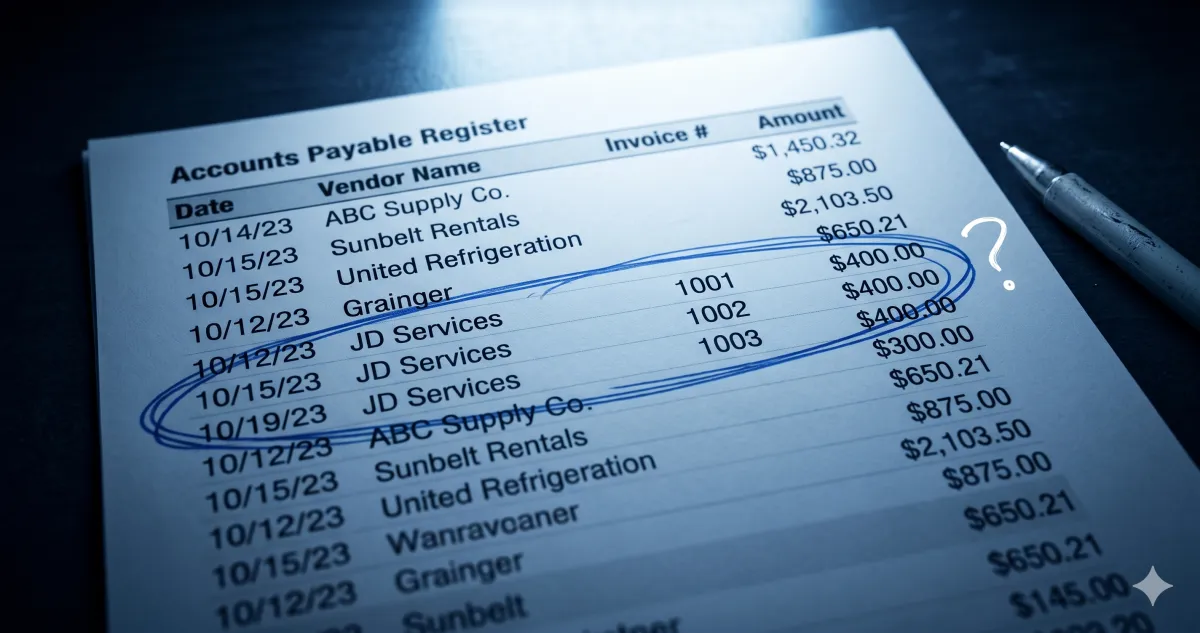
When I dug into the transaction history, a pattern emerged immediately. Small vendor payments, $200, $400, $600 at a time, going to a supplier none of us recognized. Not a supply house. Not a regular subcontractor. A vendor name that had been quietly added to the books.
Someone on the inside had created a fake vendor and was cutting themselves checks. Small enough amounts to avoid drawing attention. Regular enough to add up to a significant loss over time. It's one of the most common forms of occupational fraud in small businesses and it's almost impossible to detect without current, reconciled books.
Why Clean Books Are Your Best Fraud Protection
Here's what made the difference in this case: the books were current and reconciled. Every transaction had been reviewed. Every bank deposit had been matched. When the fake vendor payments appeared in the transaction history they stood out because everything around them was accounted for.
If his books had been behind with transactions unreviewed, bank feeds unreconciled, months of catch-up work piling up then those payments would have blended into the noise. This could have continued for years. The total loss was bad enough. Given more time it could have been catastrophic.
Monthly bookkeeping reconciliation isn't just about having accurate numbers for tax season. It's an active control that forces every dollar to be accounted for. Every vendor payment has to match a real bill. Every deposit has to match a real invoice. When that discipline is in place anomalies surface quickly. When it isn't, someone with access to your accounts can operate in the dark indefinitely.
What to Look For in Your Own Books
You don't need to suspect someone on your team to run this check. Pull your vendor payment history for the last 90 days and look for:
Vendors you don't immediately recognize
Payments that don't have a corresponding bill or purchase order
New vendors added recently that you didn't personally set up
Round-number payments that don't match any invoice
Any of those patterns warrants a closer look. Most of the time there's a legitimate explanation. Occasionally there isn't.
For a deeper look at how your books should be structured to give you this kind of visibility, read our post on Chart of Accounts for Contractors.
Frequently Asked Questions
How do contractors detect employee theft through bookkeeping?
The most reliable method is monthly bank reconciliation combined with regular vendor payment review. When every transaction is matched to a bank statement and every vendor payment is tied to a verified bill, fraudulent payments stand out. Fake vendor schemes in particular are detectable through consistent accounts payable review since any payment to an unverified vendor should require documentation before it's approved.
What is a fake vendor scheme?
A fake vendor scheme is a form of occupational fraud where an employee creates a fictitious vendor in the accounting system and submits fraudulent invoices or payment requests to that vendor. The payments go to an account the employee controls. It's one of the most common types of small business fraud because it's easy to execute when bookkeeping controls are weak and difficult to detect when books are behind or unreviewed.
How often should contractor books be reconciled to catch fraud?
Monthly at minimum. The longer the gap between reconciliations the more transactions accumulate unreviewed and the easier it is for fraudulent activity to go undetected. Weekly categorization with monthly reconciliation is the standard we recommend for trades contractors because it keeps the books current enough that anomalies surface before they compound.
If this story feels uncomfortably familiar, start with a self-audit. Our free resources including the Cash Flow Leak Scorecard are available for download here. If you want a second set of eyes on your books, book a call here.