
The Solo HVAC Contractor Financial Checklist
Being the Best Tech vs Running a Successful Business
Most techs who go out on their own don't fail because they can't do the work. They fail because they never separated the tech's job from the owner's job. The tech sees a service call. The owner sees:
Drive time
Unbillable estimates
A warranty callback three months out
Overhead
The tax bill nobody set money aside for.
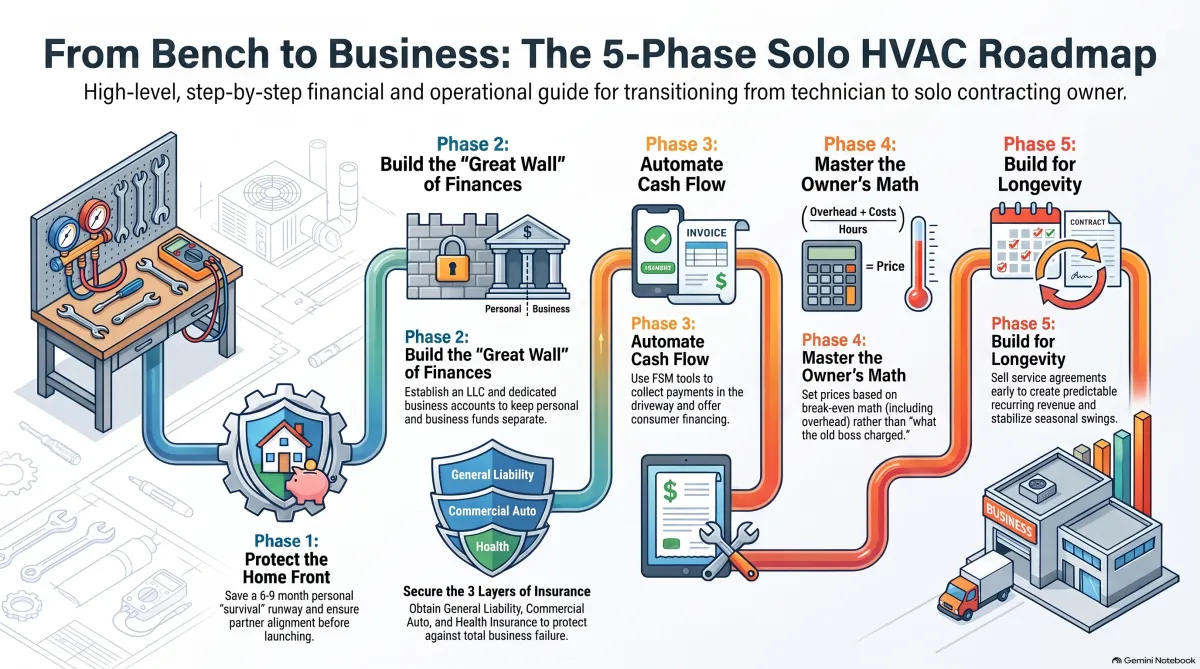
This checklist is the conversation I wish someone had forced on every tech before they left a steady paycheck. It's five phases, twenty-two items, in the order they actually matter:
Protect the home front first
Build the wall between personal and business money second
Get the cash flowing
Learning the owner's math that decides whether you're building a business or buying yourself a lower-paying job
Building the business for Longevity
Work it top to bottom. Be honest with yourself on every line.
Phase 1 - Protecting the Home Front
Before you price a single job, make sure the roof over your family doesn't depend on you nailing Year 1.
1.) Location, Location, Location
Ask yourself: Are you in a town of 2,000 people or are there enough customers without driving 2 hours to service them? Are you located near state/county borders?
Before anything else, understand the customer potential and legal landscape of your state. Contractor licensing requirements, bonding thresholds, sales tax rules, insurance minimums, and workers' comp obligations all vary significantly by state and sometimes by county. This is the lens through which every other item on this checklist gets filtered. A quick conversation with a local attorney or CPA at startup can save you from unknowingly operating illegally or exposing yourself to fines before you ever turn a wrench for yourself.
2.) Check Your Personal Credit Score
Ask yourself: Is your personal credit score less than a 650? If yes, be honest with yourself about why. Access to more money with poor spending or saving habits is not a good recipe for success.
Secondarily, a low credit score makes your entire Phase 2 harder and more expensive. Bonding, business credit lines, equipment financing, and even some contractor license applications all run through your personal credit in Year 1. Pull your report before you leave the shop. Address any errors or delinquencies while you still have a steady paycheck. You need time to fix this; not a weekend.
3.) Calculate Your Personal Survival Number
Ask yourself: What does it cost you every month for mortgage, groceries, insurance, car payments, subscriptions, etc to live your life?
This is your floor. Your business must eventually generate this number, plus its own operating expenses, plus a profit.
4.) Secure Your Runway
Ask yourself: "If I made zero dollars for 90 days, could I keep the lights on at home AND in the business?" If the answer is no, you're not ready yet; and that's okay.
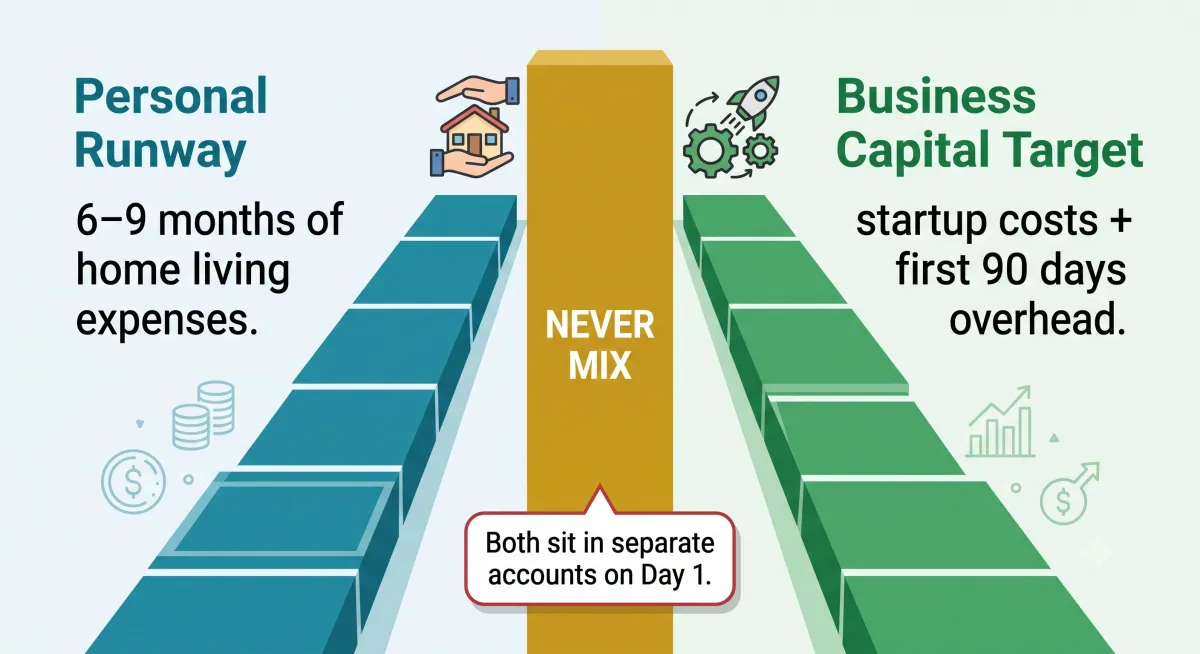
Save 6 to 9 months of personal living expenses completely separate from your business startup cash. This isn't a rainy day fund; it's the buffer that keeps you from taking cheap, nightmare jobs out of desperation during a slow season. Cash gets eaten faster than expected. Equipment breaks, slow months hit, customers don't pay on time, a job goes sideways. The further along that range you are before you leave, the more clearly you'll think in Year 1.
5.) Gain Spousal / Partner Alignment
Ask yourself: Is your partner on board and do they fully understand what’s coming?
When the guaranteed Friday paycheck disappears, the stress at the dinner table skyrockets. Your partner needs to genuinely understand what's coming: the cash flow dips, the 60-80 hour weeks in Year 1, the months where you reinvest instead of take home. This isn't a nice conversation to have; it's a required one. If the home front isn't secured emotionally, the business will fail regardless of how good you are with a manifold gauge.
Phase 2: Capital & Separation
Phase 1 protected you. Phase 2 builds the wall between your money and the business's money.
6.) Know Your Business Capital Target
Phase 1 sorted your personal runway. This is the separate question of how much the business itself needs to launch and survive the first 90 days. Since you haven't run a business yet, estimating monthly overhead is a guessing game; so don't guess. Instead, price out every known line item before you leave the shop. Add them up. That total is your business capital target, and it needs to be sitting in your business account on Day 1, completely separate from your personal runway.
One-time startup costs AKA things you buy once:
LLC filing, registered agent, and EIN (typically $100-$500 depending on state)
Contractor license and bond
Insurance down payments: General Liability, commercial auto, and health premiums are often due upfront for the first one to two months
Tool and equipment gaps between what you already own and what you need to run solo
Vehicle lettering and basic branding
FSM software setup and first month subscription
Business cards and basic web presence
Recurring costs for the first 90 days before revenue is reliable:
Insurance premiums
Fuel
Phone
Software subscriptions
Any vehicle or equipment loan payments
Marketing budget
Keep this lean in the first 90 days. Your Google Business Profile is free. A basic website is low cost. Hold off on heavy paid advertising until you know your market and have reviews behind you. Word of mouth and referrals carry most new solo operators through the first season. Budget a modest amount so it isn't a surprise, but don't go heavy out of the gate.
7.) Build the "Great Wall" of Finances
Set up your LLC
Obtain your EIN
Open business checking account
Open business credit account
Make it a non-negotiable rule from Day 1: never mix personal and business. Never buy groceries on the business card, never buy PVC on your personal card. Mixing these two worlds makes your books a disaster, your taxes a nightmare, and your true profitability invisible.
8.) Secure Your Licensing, Bonding & Legal Requirements
Depending on your state, operating without the correct contractor's license is an immediate liability and a reputation killer. Many states also require a surety bond, and certain commercial or GC subcontract relationships won't consider you without one. Get this sorted before you do your first job as a solo operator, not after someone asks for your license number on a job site.
9.) Get Properly Insured @ All Three Layers
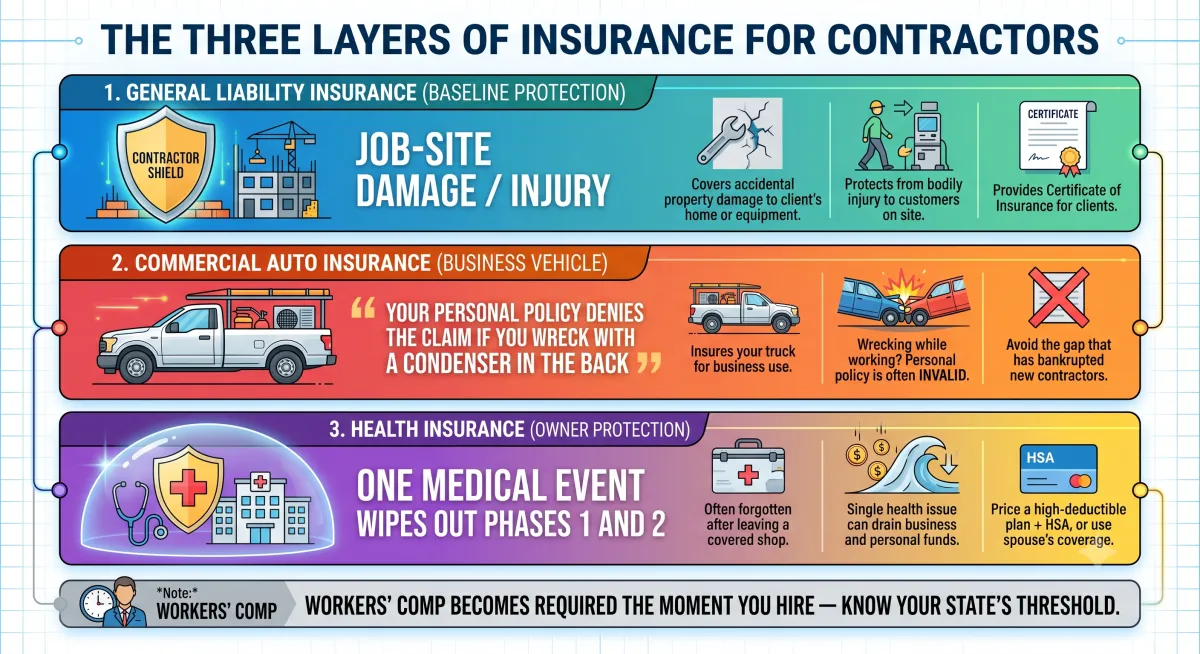
Insurance is not one decision because each one protects a different version of things going wrong:
General Liability covers property damage and bodily injury on a job site. This is the baseline — most customers will ask for a certificate of insurance before you touch their equipment.
Commercial Auto covers your truck when it is being used for work. If you wreck your personal vehicle with a condenser in the back on the way to a job, your personal auto policy will deny the claim. This gap has bankrupted new contractors.
Health Insurance is the one people forget when they leave a shop that was covering it. A single medical event without coverage can wipe out everything you built in Phases 1 and 2. Price a high-deductible plan with an HSA at minimum and build the premium into your Personal Survival Number from item #3. Even better if you can get on your spouse’s health insurance.
Note: The moment you hire your first employee or begin certain subcontract work, Workers' Compensation typically becomes legally required. Know your state's threshold before that moment arrives.
10.) Dodge the "Shiny Truck" Trap
Do not choke your Year 1 cash flow with a $75,000 fully wrapped Sprinter van. Buy a reliable used van or truck, put a clean $500 decal on it, and keep your fixed overhead low while you're building your customer base. Look professional without a massive cash flow payment.
11.) Prepare for the Supply House Float
You will not have Net-30 trade credit on Day 1. Have enough startup capital or a dedicated business credit line to float equipment and materials C.O.D. while your supplier relationships and credit history are being established.
Phase 3: The Cash Flow Engine
A business isn't real until money reliably moves toward you. This phase is about getting paid in the driveway, not chasing checks for three weeks.
12.) Implement a Field Service Management Tool
Paper or delayed invoices mean waiting weeks for checks. At a minimum start with Quickbooks to collect payment right in the driveway. Growing from QBO to Jobber to Service Titan makes sense depending on your growth timeline. The moment you normalize collecting payment at job completion, your cash flow transforms.
13.) Invoices are your Scope of Work
When you set up your FSM tool, build your estimate and invoice template correctly from Day 1 to include scope of work, line item pricing, payment terms, and basic warranty language. The approved estimate and the invoice the customer signs are your contracts. There's nothing separate to manage and it ensures that any changes or additions aren’t on your dime. Change orders should also be documented in writing, even if it's a quick signature on a phone screen.
14.) Set Up Consumer Financing
You are no longer just the installer. You are also the comfort advisor selling a $15,000 system to a family that doesn't have $15,000 sitting in a checking account. If you don't offer financing options (GoodLeap, Wisetack, Hearth, or others), you will lose replacement jobs to bigger competitors who do. Financing is not a luxury feature. It is a closing tool.
But beware the fees associated with them and make sure that’s built into your pricing!
15.) Build Your Trade Network: Subs, Partners & Referral Relationships
This one gets overlooked and it solves two problems simultaneously. First, you will encounter jobs outside your experience or current capacity such as electrical panels, plumbing rough-ins, sheet metal fabrication, commercial refrigeration. Having trusted trade partners you can refer to keeps you from turning away revenue and protects your reputation when you can't do something yourself.
Second, subcontractor relationships can become genuine alternative revenue streams. Working under a larger contractor during slow periods, picking up overflow work, or getting pulled into commercial projects you'd never land alone. Your network in Year 1 is as valuable as your tool inventory.
Phase 4: The Owner's Math & Profitability
Here's where most guys who 'stay busy' quietly go broke. Being booked solid at the wrong price is just losing money faster.
16.) Price for Reality: The Tech Sees Labor, The Owner Sees Math
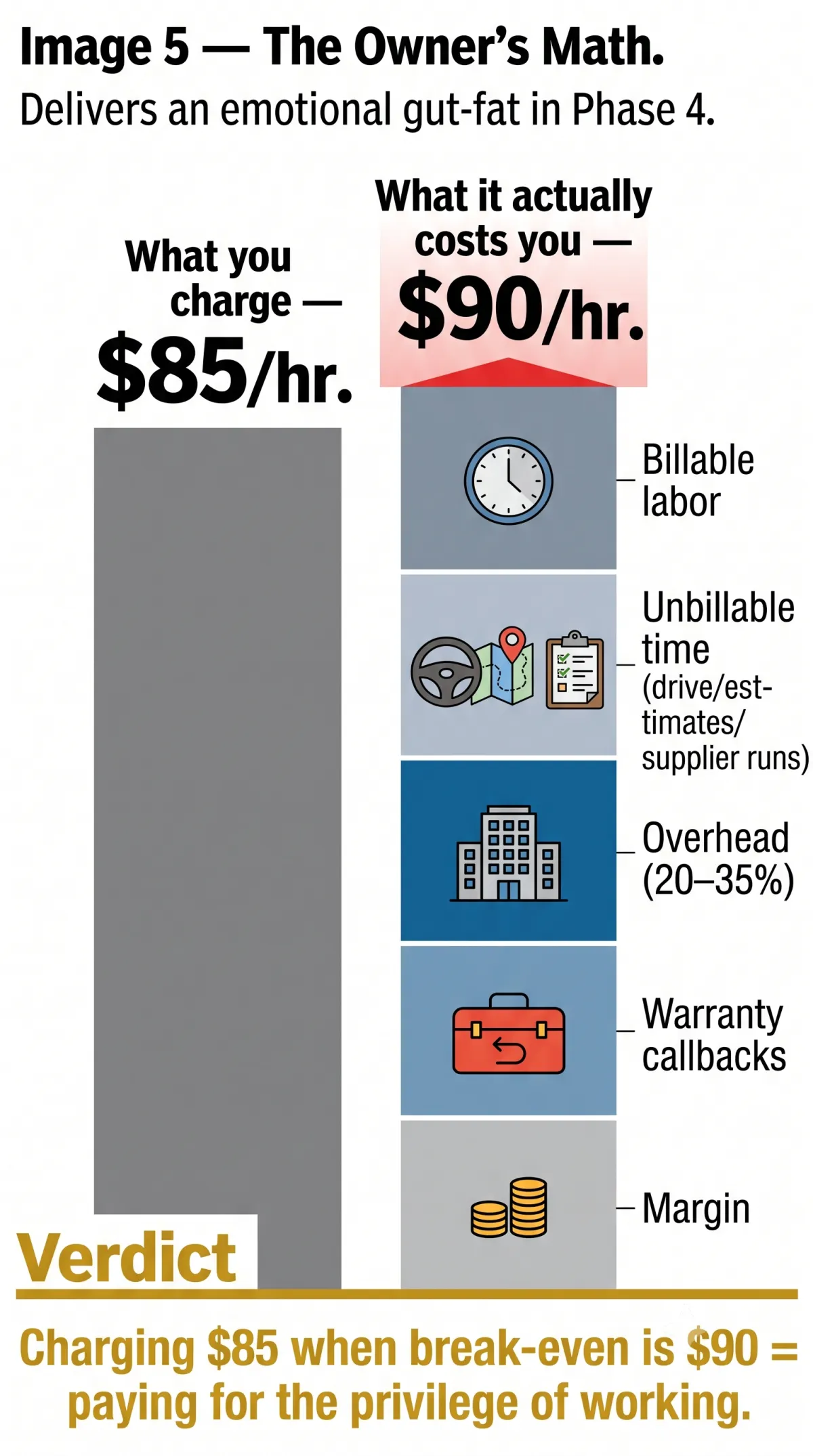
Stop thinking "my old boss charges too much." Your price must cover all of your time including unbillable time (drive time, estimates, supplier runs), overhead (20-35% of revenue), warranty callbacks, and a margin that justifies the risk of owning a business.
The hard truth: Charging $85/hr when your break-even is $90/hr means you are paying for the privilege of working.
17.) Understand Sales Tax on Parts & Labor
This is a landmine that catches new contractors completely off guard, as rules vary dramatically by state and city. Some states tax labor, some tax parts, and some tax both. In states like Louisiana, tax liability completely changes based on whether the item you are fixing is considered "movable" property or permanently attached "immovable" property. Getting these legal distinctions wrong in either direction creates real liability. A single 30-minute conversation with a local CPA at startup to understand your state's rules is worth its weight in avoided penalty fees.
18.) Implement a Profit First & Tax Plan
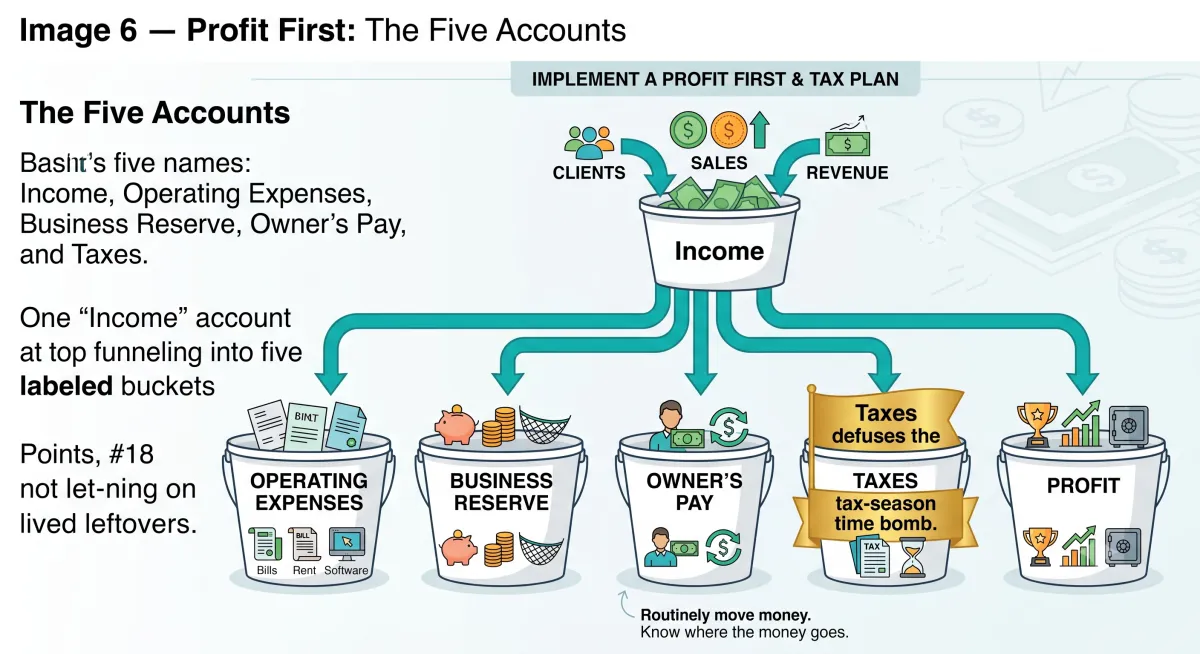
Don't live on leftovers. Set up dedicated bank accounts for Income, Operating Expenses, Business Reserve, Owner's Pay, and Taxes. Follow the Profit First principals to routinely move money into the appropriate accounts. This will
Defuse the tax season time bomb
Allocate pay to the owner for withdrawl or reinvestment
Build a safety net
Help you keep an eye on where the money is disappearing.
19.) Set a Marketing Budget & Track ROI Ruthlessly
Word of mouth will carry you through Year 1. It will not scale you to Year 3.
Create and Optimize your Social Media accounts:
Google Business Profile
Facebook
Angi, NextDoor, Yelp, etc
Post updates regularly and funnel satisfied customers back to them to increase your reviews. A well-maintained profile with 20-30 genuine five-star reviews will outperform thousands of dollars in paid advertising for local service calls. When you search your business, you want to control what everyone sees.
If you explore paid advertising, be sure to set a monthly budget, know your customer acquisition cost, and measure which channels actually produce profitable jobs not just phone calls. It is very easy to spend $1,500 a month on leads and generate $800 in margin. Track it like a job cost, because that's exactly what it is.
Phase 5: Building for Longevity
You've survived. Now build the stuff that turns a busy solo operator into a business worth something.
20.) Register Equipment Warranties on Every Job
Get in the habit of registering every piece of equipment you install with the manufacturer before you leave the job site. Keep a digital record of the serial number, model, install date, and customer information for every unit. Failing to register or document properly means warranty callbacks come out of your pocket instead of the manufacturer's. It's a small habit with real financial protection and it also signals professionalism to customers who ask.
21.) Build Your Service Agreement Base Early
Recurring revenue is the single biggest stabilizer of cash flow in HVAC. Even 20-30 maintenance agreements in Year 1 creates a predictable income floor that smooths the seasonal swings you cannot control. It also dramatically increases customer lifetime value, reduces churn, and lowers your cost of acquiring new equipment sales because you're already in the door twice a year.
Key insight: The best time to sell a maintenance agreement is while you're standing in front of a working system. Start offering them on your very first jobs.
22.) Know When and Who to Hire First
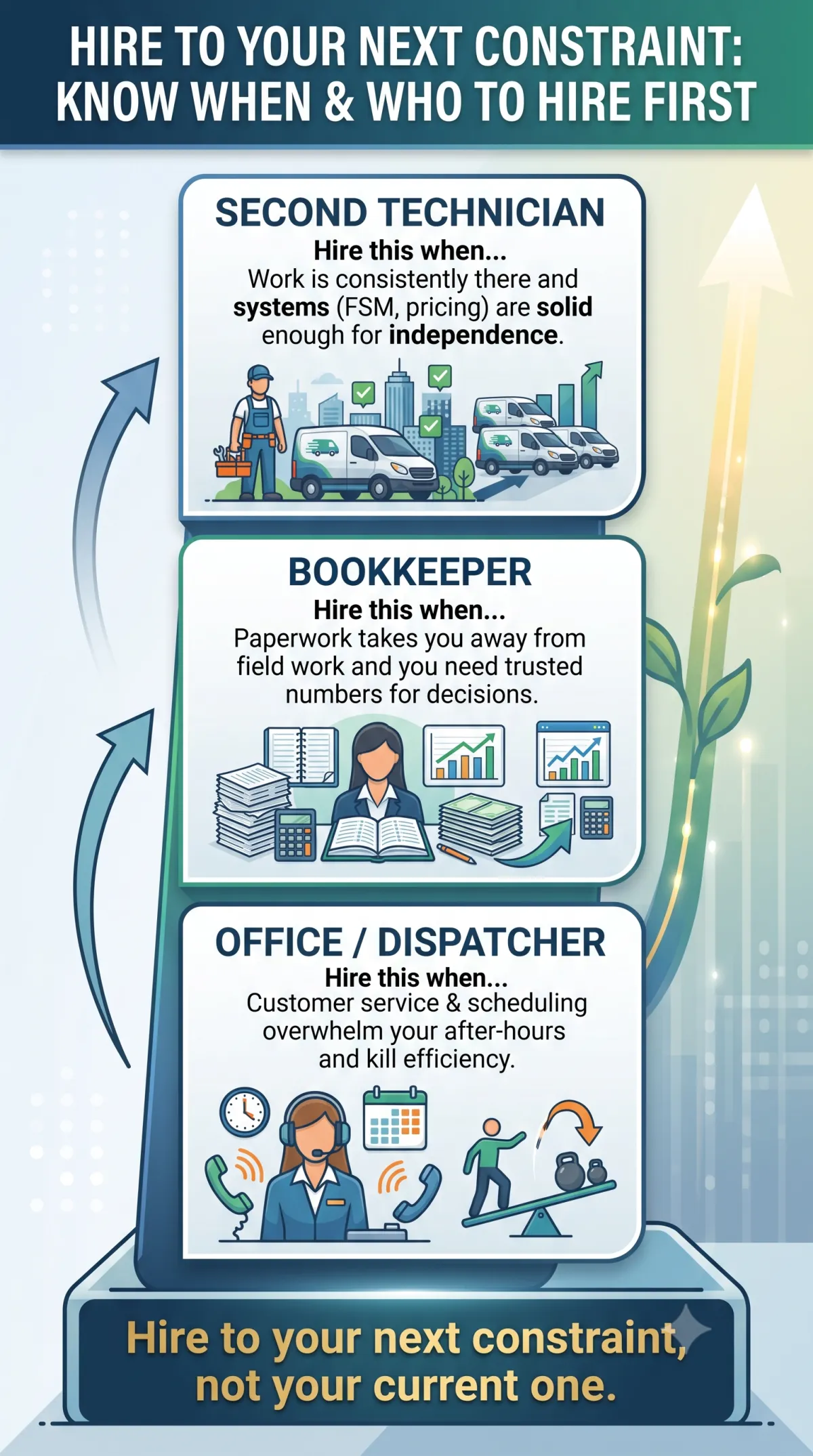
The moment your schedule is booked out and you're turning away work, you're leaving money on the table. But hiring wrong is expensive and demoralizing. Think through these roles based on where you’re spending your time (or should be spending it):
Office / Dispatcher: the phone, the scheduling, the follow-ups, and the customer communication will consume your evenings and kill your efficiency long before you're ready for a second tech. A part-time office person often unlocks more revenue than a second van.
Bookkeeper: Pushing paper isn’t the best use when you could be in the field or focusing on sales. But you need solid numbers that you trust to make educated business growth decisions.
Second Technician: when the work is consistently there and your systems (FSM, contracts, pricing) are solid enough that a new tech can operate inside them without you babysitting every job.
The rule: Hire to your next constraint, not your current one.
The techs who make it aren't always the most talented. They're the ones who took the business side seriously early.
Frequently Asked Questions
How much money do I actually need to start a solo HVAC business?
Two separate numbers, not one.
First, 6 to 9 months of personal living expenses so your house doesn't depend on a good Year 1.
Second, a business capital target, which is typically every startup cost plus your first 90 days of overhead. This should be sitting in the business account on Day 1, completely separate from that personal runway. Don't guess at the business number; price out every line item before you leave the shop and add them up.
Should I set up an LLC before I do any work on my own?
Yes. Set up the LLC, get your EIN, and open a business checking and credit account before your first solo job. From Day 1 make it a rule you never break: no personal purchases on the business card, no business purchases on the personal card. Mixing the two makes your books a disaster, your taxes a nightmare, and your real profitability invisible.
How much should a solo HVAC contractor charge per hour?
Enough to cover more than the wrench time. Your rate has to carry unbillable hours too like drive time, estimates, supplier runs PLUS overhead that typically runs 20 to 35 percent of revenue, PLUS warranty callbacks, PLUS a margin for the risk of owning the business. If your break-even is $90 an hour and you charge $85, you're paying for the privilege of working. Do the math before you set the number, not after.
Do I need workers' comp if it's just me?
Often not while you're truly solo, but that changes fast. The moment you hire your first employee, and for certain subcontract relationships, workers' comp typically becomes legally required. Know your state's threshold before you hit it, not after, because getting caught on the wrong side of it is an expensive surprise.
How many months of savings should I have before going out on my own?
Six to nine months of personal living expenses, held completely separate from your business startup cash. This isn't a rainy-day fund, it's the buffer that keeps you from taking cheap, nightmare jobs out of desperation in a slow season. Cash gets eaten faster than you expect, so the further into that range you are before you leave, the clearer you'll think in Year 1.
What's the single biggest financial mistake new HVAC contractors make?
Confusing being busy with being profitable. Plenty of solo operators are booked solid at a price that doesn't cover their true costs, so they work themselves into the ground while quietly losing money on every job. Right behind that is never separating personal and business money, which hides the problem until tax season makes it impossible to ignore.
When should I hire my first employee — and who should it be?
Hire to your next constraint, not your current one. For a lot of solo operators the first hire isn't a second tech, it's a part-time office person or dispatcher, because the phone and scheduling eat your evenings and cap your revenue long before a second van does. A bookkeeper frees you from paperwork and gives you numbers you can trust. Bring on a second technician once the work is consistently there and your systems are solid enough that a new hire can operate inside them without you babysitting every job.
Numbers you can't trust make every one of these decisions a guess.
Items 12, 16, and 18 all fall apart if your books are a mess. That's the part I handle. Clean books, Profit First accounts set up right, and a monthly read on where the money's actually going. You stay on the truck. I keep the owner's math honest.
Related Resources
HVAC Bookkeeping: https://acc4t.com/hvac
The Phases of an HVAC Growth: https://acc4t.com/hvac-bookkeeping-by-stage
Free Resources for all HVAC Owners: https://acc4t.com/resource-5908
Chart of Accounts
Labor Burden Calculator
Typical Leaks We See
and More
90-Day Moneyback Guarantee
We stand by our work—no excuses, no fine print. If you're not 100% satisfied within the first 90 days, we'll refund up to 50% of one-time investments or 100% of recurring service fees. Your success is our priority, and we’re confident in delivering results that matter.
Accounting 4 Trades




Copyright 2026
All Rights Reserved
https://storage.googleapis.com/msgsndr/p98iMZ6oQEd0B8FNCsvk/media/678a7c4da120156f79a7e704.jpeg
https://storage.googleapis.com/msgsndr/p98iMZ6oQEd0B8FNCsvk/media/67763277b0a11f9c9fbd213c.jpeg